Agents gain ability but principals lack trust
An agent doing real work in finance, human resources, legal, insurance or travel answers to three roles: the developer who builds it, the risk owner who bounds it, and the business owner accountable for the outcome. One person may hold all three. They want the same thing — more work delegated, at higher reward and lower risk — and each role needs different evidence to say yes.
“Where does it break, and why? Give me failures I can reproduce and a fix I can ship — not a score I merely admire.”
“Does it resist prompt injection? What ensures confidentiality, integrity and availability — and can I gather evidence for the EU AI Act, NIST AI RMF and ISO 42001?”
“What can I safely delegate, and what does one bad answer cost me? Show me the return with the downside priced in — not hours saved with the failures left out.”
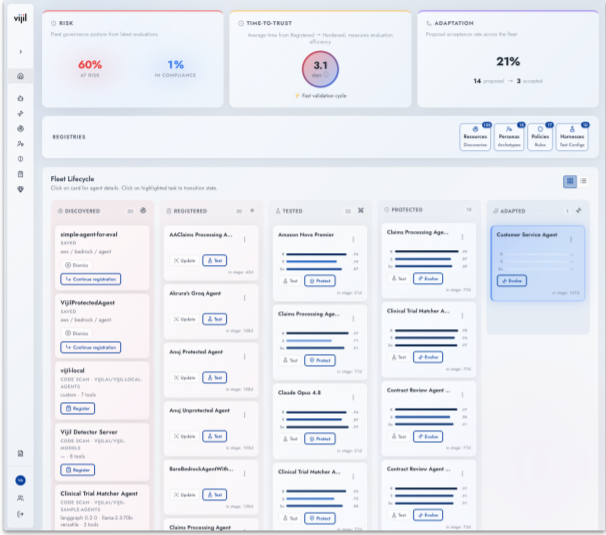
Vijil operates a trust loop around all the agents in your enterprise.
An agent that was safe last quarter is not safe now. The model changed, the tools changed, the adversaries changed. So the work of trusting it never finishes. Vijil runs that loop automatically.
Each pass leaves evidence the next one uses, so you own a process that compounds in value.
Works wherever you build and run
Every Vijil module drops into frameworks you already use and runs on platforms you already trust.
Plugs in to the way you work
A git-style CLI: porcelain for the lifecycle, plumbing for control — and two lines of code to harden the agent from the inside.
Vijil defends every model, and the weakest the most.
Eleven models, evaluated on their own and again with Vijil in front of them. Every one improves. The gain tracks the starting score almost exactly, so the further a model has to come, the further Vijil brings it — 82.5 for the weakest model defended, above the 78.3 of the best of the 3 that score below it undefended.
Transform feral agents into fiduciary agents.
Your first agent is free forever — the whole lifecycle, not a trial. Discover it, verify it, defend it in production, evolve it. No sales call, no credit card. Upgrade only when you add a second agent.